
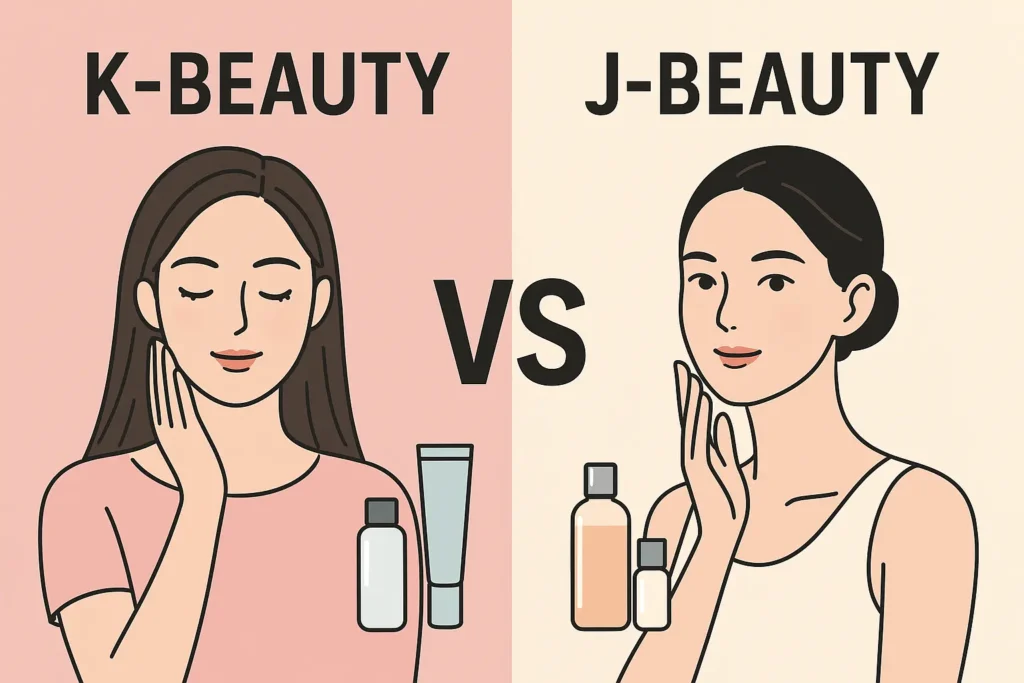
The beauty media frames these two approaches to skincare as cultural philosophies: Japanese skincare as a minimalist ritual and Korean skincare as innovative layering. In reality, it’s marketing positioning for two mature skincare markets competing globally. One isn’t better than the other, but one might be less effective for your skin type, routine tolerance, and actual concerns.
Surprisingly, the biggest difference is actually accessibility. You can walk into Sephora and find numerous Korean brands. Japanese products? You’re relying on speciality retailers with limited information and longer shipping times.
This isn’t a cultural philosophy debate. It’s about formulation priorities, routine tolerance, and whether you’re willing to deal with limited product availability for potentially superior technology.
What Actually Makes Them Different
Not aesthetics. Products, formulations, and business models.
Japanese approach:
- Fewer steps, higher-quality base formulations, focus on protection and prevention. Sunscreen is never skipped. Lightweight textures. Minimal fragrance. Brands like Shiseido, Hada Labo, Rohto spent decades perfecting core products.
Korean approach:
- Multi-step layering, trend-driven innovation, focus on treatment and results. Essence-heavy routines. Textural variety. Quick product cycles. Brands like COSRX, Innisfree, Sulwhasoo prioritise novelty and ingredient trends.
The “mochi skin vs glass skin” is Instagram marketing, not dermatology. Both want hydrated, smooth, protected skin. The difference is how many products you’re willing to layer and whether those products are actually available where you shop.
The Accessibility Problem
Korean skincare dominates because it’s designed for export with brands being widely available in most retailers such as Amazon Prime, Sephora, etc. Easy returns. English instructions. Affordable.
Japanese skincare primarily focuses on its massive domestic market first. Brands rarely prioritise international distribution. You’re ordering from speciality retailers, dealing with product descriptions in Japanese, and paying international shipping.
This matters commercially because Korean brands captured global market share through aggressive marketing and distribution. The global K-beauty market ($11.56 billion in 2024) grows faster than Japan’s larger but domestically-focused beauty market ($32.02 billion). You can easily impulse-buy Korean skincare, but Japanese skincare requires research and longer shipping times.
Where to Actually Buy Products
Korean skincare :
- Boots – Limited K-beauty selection (COSRX, Some By Mi), in-store and online
- Cult Beauty – Curated K-beauty selection, UK-based, free delivery over £40
- Beauty Bay – Good Korean range, frequent sales, UK shipping
- LookFantastic – Growing K-beauty section, UK retailer
- YesStyle – Huge selection, free shipping over £35, delivery 2-3 weeks
- Olive Young Global – Official Korean retailer, ships to UK
- Stylevana – Discounted Asian beauty, ships to UK, 2-4 week delivery
- K Beauty World – UK-based specialist Korean beauty retailer
The liste below are just a few of retailers where you can purchase Korean skincare products , it could easily be twice as long.
Japanese skincare:
- YesStyle – Largest English-language selection for Japanese products
- Dokodemo – Japanese marketplace, ships to UK, interface partially in Japanese
- YesAsia – Alternative to YesStyle, ships to UK
- Stylevana – Ships to UK, longer delivery times
- Japan Centre (London physical store + online) – Limited selection, authentic products
- eBay UK (reputable sellers only) – Check seller ratings carefully, counterfeit risk
- Physical Japanese grocery stores – If you live near one, check beauty sections
Routine Structure: Time Investment vs Results
Here’s where marketing diverges from reality. The “10-step Korean routine” you hear about? It’s nonsense. According to Korean Ministry of Food and Drug Safety surveys, Korean women in 2015 averaged 5-8 products daily. By 2021, a Kantar study found 28% use just 3 products in their morning routine, 23% use only 2 products. The trend is toward “Skip-Care” to prevent irritation.
Japanese baseline (3-5 steps):
- Double cleanse (oil + foam)
- Hydrating toner/lotion
- Emulsion or light moisturiser
- Sunscreen (always)
- Treatment serum (if needed)
Japanese minimalism is a practical necessity in humid climates where heavy layering feels suffocating.
Korean standard (5+ steps):
- Oil/water based cleanser
- Exfoliant (2-3x weekly)
- Toner
- Essence
- Serum
- Sheet mask (weekly)
- Eye cream
- Moisturiser
- Sleeping pack/night cream (optional)
Who each approach serves:
- Japanese: Time-poor, texture-sensitive, humid climates, prevention-focused, irritation-prone skin
- Korean: Skincare enthusiasts, normal/dry skin, colder climates, treatment-focused, enjoys the ritual.
Ingredient Priorities: Prevention vs Innovation
Japanese skincare tends to rely on long-established active ingredients with decades of regulatory use and clinical safety data, such as hyaluronic acid, tranexamic acid, arbutin, and rice-derived ferments.
Korean skincare more frequently introduces newer or trend-driven ingredients into mainstream products. While many of these ingredients are promising and often effective, they may have a smaller body of long-term, peer-reviewed research at the time they reach consumers.
Japanese staples:
- Hyaluronic acid (early cosmetic adoption led by Japanese brands)
- Rice bran and sake derivatives
- Tranexamic acid for brightening
- Advanced UV filters (Tinosorb, Uvinul)
- Arbutin for hyperpigmentation
Korean trends:
- Snail mucin, bee venom, starfish extract (whatever’s novel)
- Fermented ingredients (galactomyces, bifida)
- Centella asiatica
- Propolis and honey
- Niacinamide (common in many products)
Both use fermented ingredients. Japan (sake, rice ferments) has centuries of traditional use. Korea (galactomyces, bifida ferment filtrate) industrialised it for skincare in the 2000s. The mechanism is similar: fermentation breaks down molecules for better skin penetration and produces beneficial metabolites.
Where Both Approaches Get Sunscreen Right (and Wrong)
The difference lies in formulation trade-offs: Korean sunscreens often optimise cosmetic elegance, fast absorption, and affordability, while Japanese sunscreens more consistently maximise UVA protection alongside long-term wearability.
To achieve serum-like finishes and eliminate white cast, some Korean formulas rely on different UV filter ratios or less emphasis on long-wave UVA filters . These products still offer solid protection and generally outperform most U.S. sunscreens, but they may prioritise texture over maximal UVA coverage in pursuit of daily wear comfort.
Japanese sunscreens benefit from access to advanced UV filters such as Tinosorb S, widely regarded in photobiology research as among the most effective and photostable UVA/UVB filters available. These filters maintain protection under sun exposure, cover long-wave (“far”) UVA, and resist degradation in sunlight. Years of formulation refinement have produced sunscreens that balance high-level protection with lightweight, wearable textures but often at a higher cost.
Japanese Sunscreen Advantages
- Among the most advanced UV filter technology globally
- Cosmetically elegant textures
- High UVA protection (PA++++)
- Wearable for daily use
Korean Sunscreen Innovation
- Lightweight, moisturising formulas
- Affordable and widely accessible
- Less white cast than Western alternatives
- Good UVB protection, variable UVA protection
The trade-off is tolerance. Many Japanese sunscreens include alcohol to achieve fast-drying finishes, which can irritate some skin types. Korean sunscreens may include fragrance, which irritates others. Neither approach is universally superior and tolerance to specific irritants matters more than country of origin.
The Product Categories That Actually Matter
Skip the listicles. Here’s what’s genuinely worth attention:
Japanese products that outperform:
- Sunscreens (Anessa, Bioré, Skin Aqua)
- Cleansing oils (DHC, Hada Labo, Fancl)
- Hydrating toners (Hada Labo Gokujyun, Naturie Hatomugi)
Korean products that deliver:
- Essences (COSRX Snail 96, Missha Time Revolution)
- Sheet masks (affordable, effective hydration delivery)
- Low-pH cleansers (COSRX Good Morning, Innisfree Blueberry)
Where both fail: Anti-ageing. Neither Japanese nor Korean OTC products approach Western retinoid efficacy. If you want real anti-ageing results, you need tretinoin or adapalene, not fermented yeast extract.
The Verdict
Korean skincare dominates internationally because it was built for export. Products are widely available through major global retailers, packaged in English, and easy to repurchase.
Japanese skincare primarily serves its domestic market. International buyers often rely on specialty retailers, longer shipping times, and limited product information. While Japanese products often come in larger sizes and require fewer steps, sourcing requires more planning.
This difference shapes perception: Korean skincare feels convenient and inexpensive upfront, while Japanese skincare often costs more per item but less in total routine complexity.
Frequently Asked Questions
Can you mix Japanese and Korean skincare products?
Yes. Use Japanese sunscreens for superior UV protection, Korean essences if you want extra hydration layers, and choose cleansers and moisturisers by texture preference, regardless of origin. Your skin responds to formulations, not cultural authenticity.
Which skincare is better for sensitive skin: Japanese or Korean?
Japanese skincare typically suits sensitive skin better. Formulations prioritise gentle, fragrance-free ingredients with decades of safety data. Korean products often introduce novel ingredients that lack long-term sensitivity research. However, Korean brands like Purito and Dr. Jart+ specifically target sensitive skin.
Do Japanese or Korean products work better for anti-ageing?
Neither significantly outperforms Western retinoid products for anti-ageing. Japanese brands use tranexamic acid and arbutin for prevention. Korean brands emphasise fermented ingredients and peptides. For measurable anti-ageing results, tretinoin or adapalene (Western) remains superior to both.
Why is Japanese sunscreen considered better than Korean?
Japanese sunscreens use advanced UV filters (Tinosorb, Uvinul) with superior UVA protection and cosmetically elegant textures. Korean sunscreens prioritise a lightweight feel and affordability, but sometimes prioritise cosmetic elegance over long-wave UVA robustness. Japanese formulations balance protection and wearability more effectively.
What does “glass skin” vs “mochi skin” actually mean?
Marketing aesthetics, not dermatological goals. “Glass skin” (Korean) suggests reflective, translucent luminosity. “Mochi skin” (Japanese) implies soft, bouncy texture. Both describe well-hydrated, smooth skin with healthy barrier function. The difference is branding, not biological outcome.